Perception, Not Reasoning, Limits Video Spatial Understanding

SPLIT: Separating Perception from LLM Inference with Tools

1Carnegie Mellon University 2Google 3Unity
Correspondence: jacobyeung@cmu.edu
Abstract

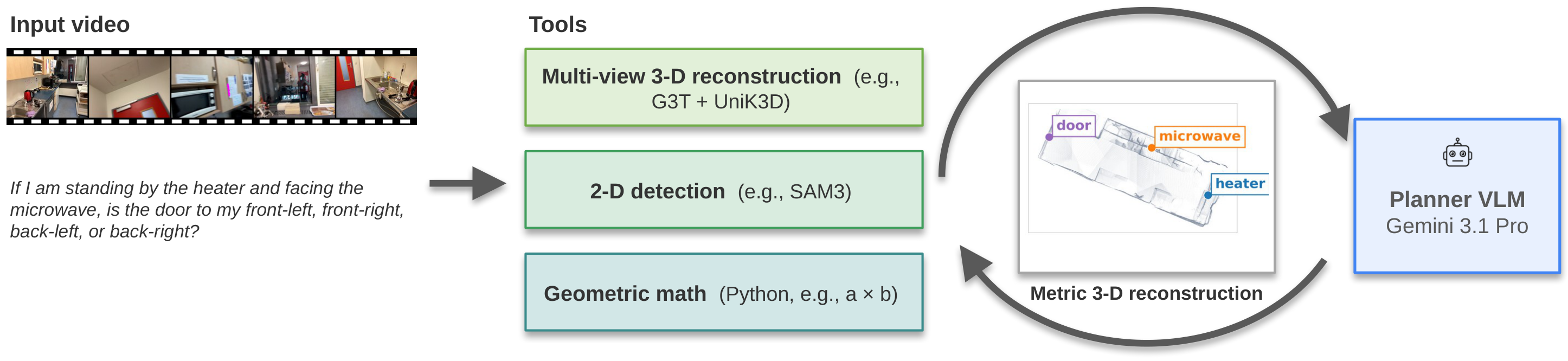
Wearable AI assistants must track objects across egocentric video to help users in physical spaces. Current vision-language models (VLMs) struggle with spatial questions that require combining observations from different moments. An overall score does not reveal whether their errors come from perceiving the scene or reasoning about it. We introduce SPLIT, a training-free harness that reconstructs one metric 3-D point cloud from a video and gives a planner VLM tools to query it. Frozen reconstruction and grounding models locate objects and measure their geometry, and the planner VLM combines those measurements using Python. We train no model parameters on the evaluated benchmarks. SPLIT improves accuracy on VSIBench, VSTIBench, and ReVSI. On VSTIBench, it raises accuracy from 57.7% to 78.3%, eliminating 49% of the baseline VLM's errors; across all three benchmarks, the largest gains occur when questions relate objects seen in different frames. SPLIT achieves the best published training-free score on VSIBench and exceeds published scores on VSTIBench and ReVSI. To measure how much error comes from perception, we rerun SPLIT with ground-truth measurements in place of the tools' estimates. On the VSTIBench analysis subset, the baseline VLM scores 59.0%, SPLIT scores 79.7%, and SPLIT + GT reaches 95.7%. This gain shows that inaccurate perception remains a major source of error.

Our Contributions
  1. SPLIT is a harness that reconstructs a metric 3-D point cloud per video and gives a planner VLM perception tools to query it. SPLIT achieves the best training-free score on VSIBench and the best published score on VSTIBench and ReVSI.
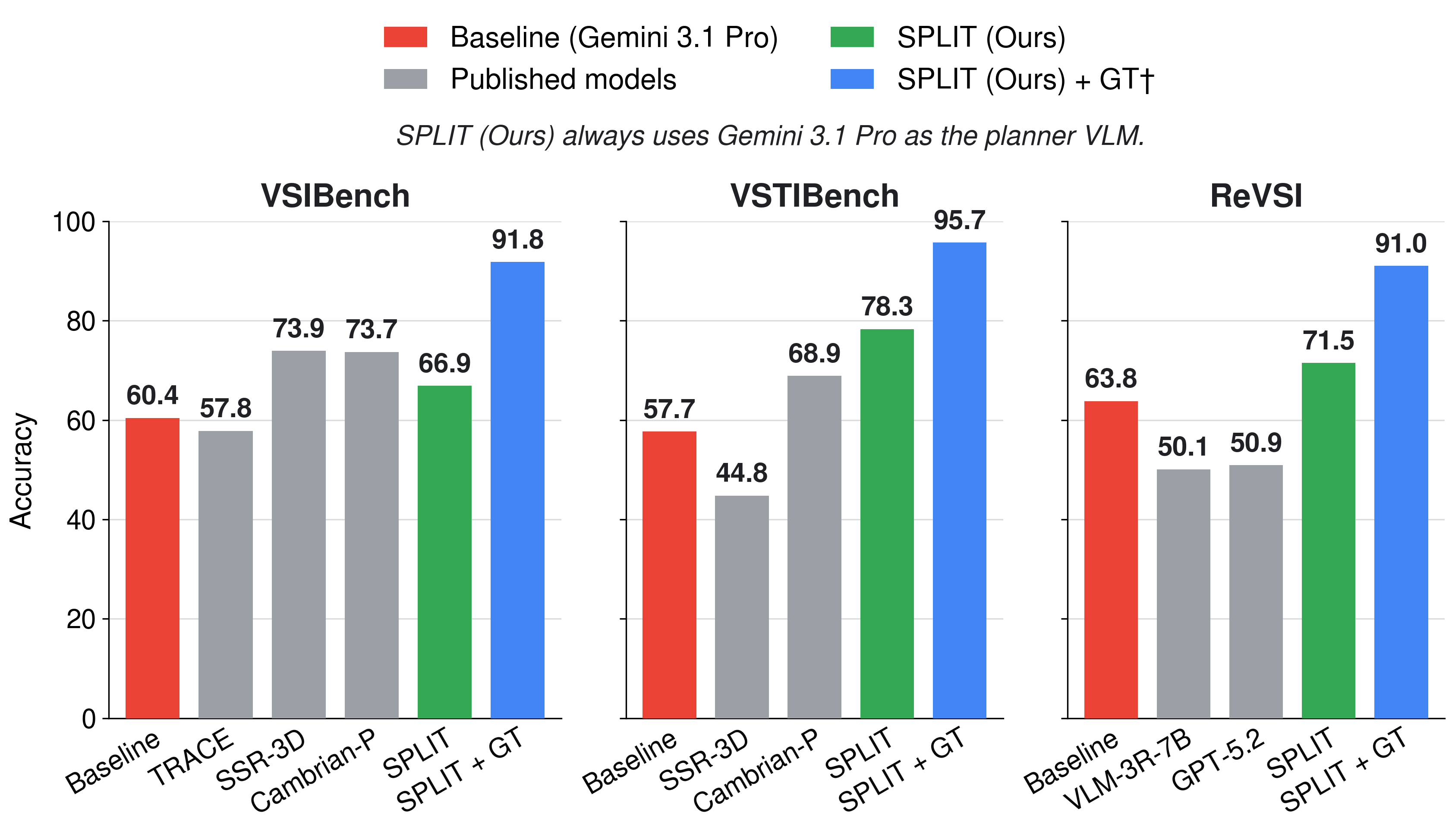
  2. Replacing the tools’ estimates with ground-truth measurements lifts SPLIT from 66.9 / 78.3 / 71.5 to 91.8 / 95.7 / 91.0 on VSIBench, VSTIBench, and ReVSI. Perception, not reasoning, limits current VLMs.
Sample Question
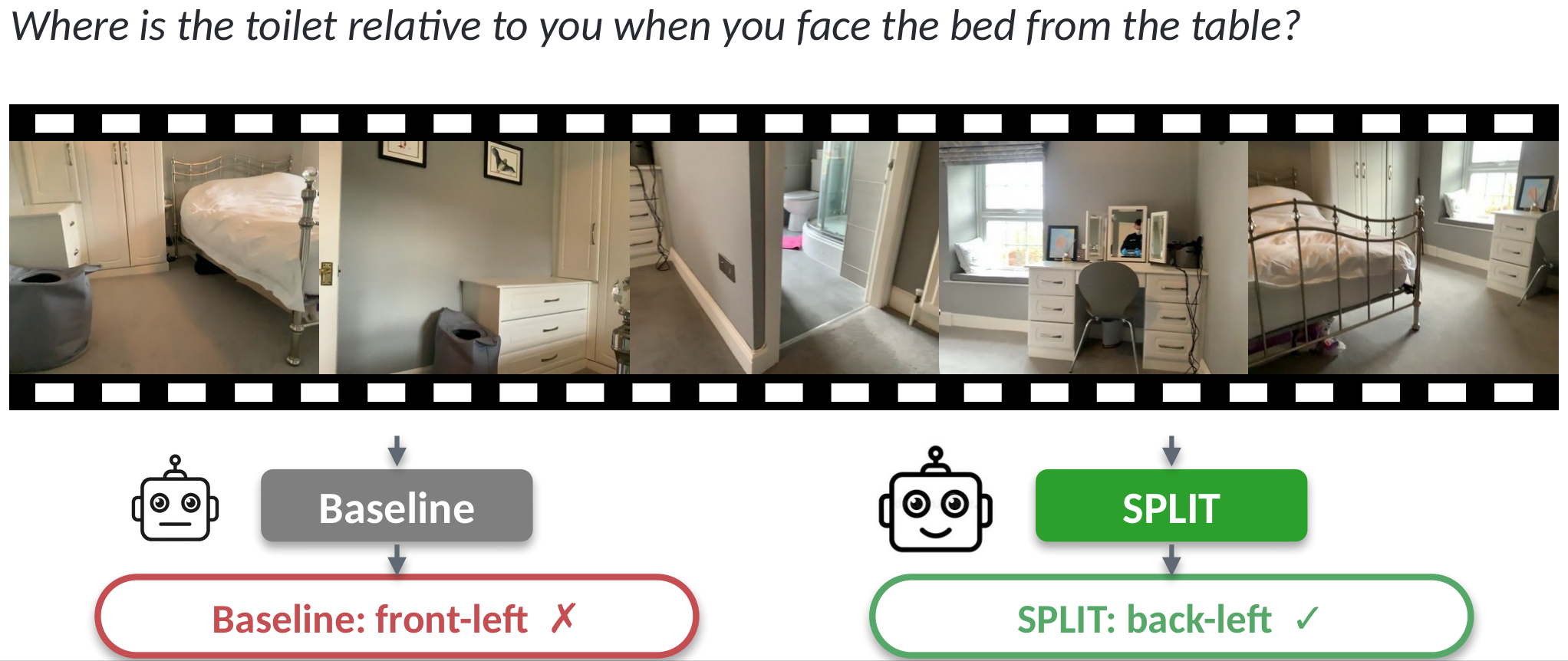
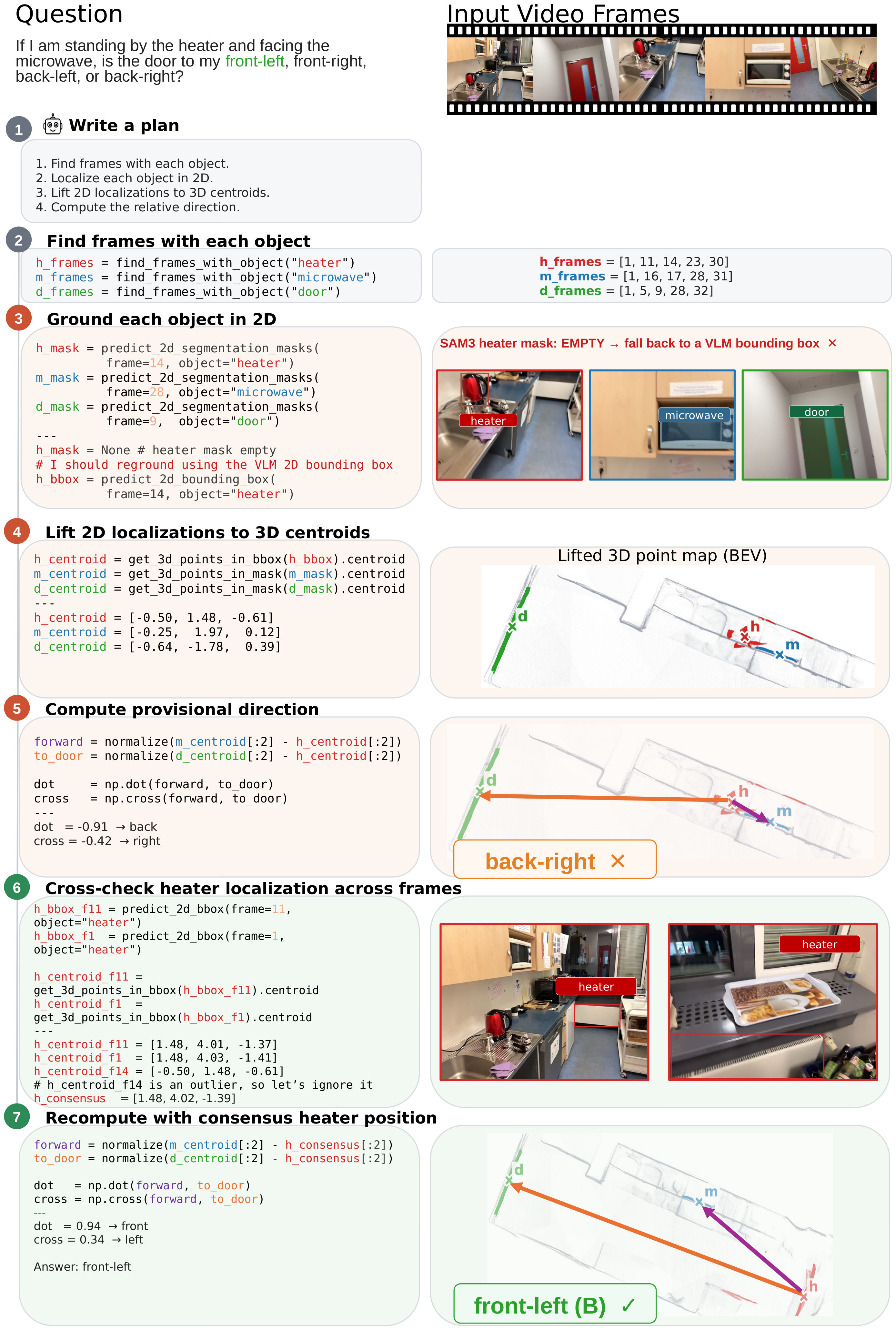
A sample spatial question with the baseline answer and the SPLIT answer.
Pipeline
The SPLIT pipeline: reconstruction and grounding models build a metric point cloud that the planner VLM queries with tools.
Walkthrough of a Question
A step-by-step trace of SPLIT answering one question.
SPLIT Improves Video Spatial Reasoning
Method VSIBench VSTIBench ReVSI
Proprietary
GPT-4o34.038.2–
Gemini-2.5 Pro51.542.4–
GPT-5.249.2–50.9
Gemini 3 Flash55.9–57.6
Gemini 3 Pro60.5–60.9
Open-source
Qwen3-VL-8B57.4–49.1
InternVL3.5-38B60.8–54.1
LLaVA-Video-72B39.744.037.8
Supervised spatial specialists
VLM-3R-7B60.958.850.1
Cambrian-S-7B67.5–49.1
GeoThinker-8B72.667.4–
Cambrian-P73.768.9–
SSR-3D73.944.8–
Baseline VLM (Gemini 3.1 Pro)60.457.763.8
SPLIT w/ Gemini 3.1 Pro (Ours) 66.9 (+6.5) 78.3 (+20.6) 71.5 (+7.7)
SPLIT (Ours) + GT91.8†95.7†91.0†

Bold and underlining mark the best and second-best full-benchmark scores. † Ground-truth cells use the corresponding analysis subsets; VSIBench and ReVSI counting are oracle ceilings.

Bar chart of benchmark scores for the baseline VLM, SPLIT, and SPLIT with ground-truth measurements.

† SPLIT (Ours) + GT is measured on each benchmark's analysis subset; VSIBench and ReVSI counting are oracle ceilings.

VSIBench

Numerical Multiple choice
MethodTrainAvg. Obj.
Count
Abs.
Dist.
Obj.
Size
Room
Size
Rel.
Dist.
Rel.
Dir.
Route
Plan
Appr.
Order
Human–79.294.347.060.445.994.795.895.8100.0
General-purpose VLMs
GPT-4oTF34.046.25.343.838.237.041.331.528.5
Gemini-1.5 ProTF45.456.230.964.143.651.346.336.034.6
Gemini-2.5 ProTF51.543.834.964.342.861.147.845.971.3
Supervised spatial specialists
Think-with-Spatial-CodeRL54.958.339.073.052.457.855.938.763.9
+ 2D boxRL60.195.260.750.833.187.162.032.559.0
VLM-3R-7BSFT60.970.249.469.267.165.480.545.440.1
Cambrian-S-7BSFT67.573.250.574.972.271.176.241.880.1
SpaceMind++ (InternVL3-8B)SFT73.474.562.477.976.973.589.748.284.1
Cambrian-P (Qwen2.5-7B)SFT73.774.960.176.076.974.889.552.685.0
SSR-3D (openPangu-VL-7B)SFT73.970.567.176.079.571.393.448.585.0
Training-free methods
ViSRA (Qwen2.5-VL-7B)†TF50.346.427.860.147.751.371.743.853.7
TRACE (Gemini 3 Pro)TF57.847.638.873.945.663.961.758.073.0
Full benchmark
Baseline VLMTF60.451.243.673.353.169.262.458.871.7
SPLIT (Ours)TF66.950.058.366.156.369.990.073.770.7
Δ+6.5-1.2+14.7-7.2+3.2+0.7+27.6+15.0-1.0
Debiased subset
Baseline VLMTF57.546.441.262.954.669.062.351.871.7
SPLIT (Ours)TF65.850.956.460.257.571.686.771.172.3
Δ+8.3+4.5+15.2-2.7+2.8+2.6+24.4+19.3+0.6
Ground-truth diagnostic‡
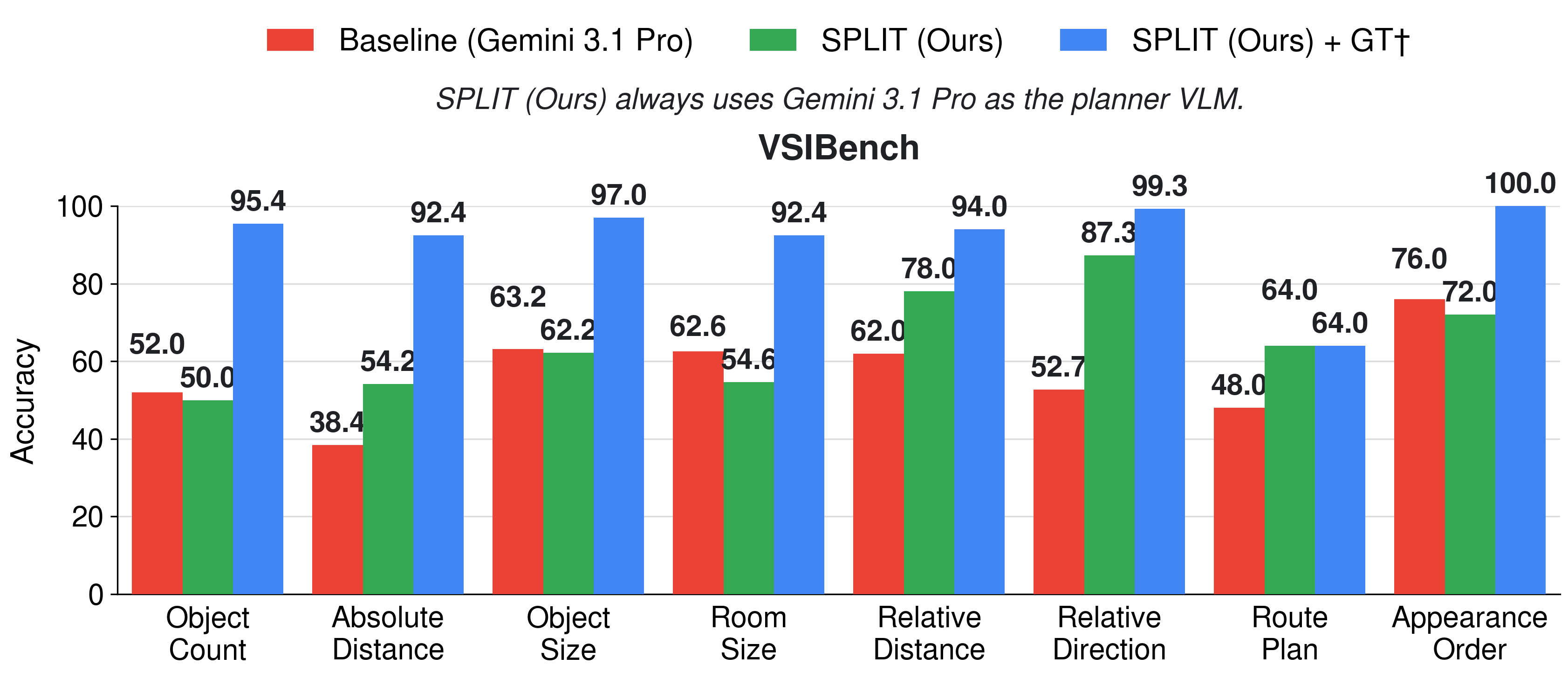
SPLIT (Ours) + GTTF91.895.492.497.092.494.099.364.0100.0

Bold and underlining mark the best and second-best full-benchmark model scores. “TF” is training-free, “RL” reinforcement learning, and “SFT” supervised fine-tuning. † Subset result reported by ViSRA. ‡ Ground-truth diagnostic; the analysis subset is described in the paper, counting is an oracle ceiling, and appearance order uses a fixed 50-question cohort shared by every arm.

VSTIBench

MethodTrainAvg. Cam-Obj
Abs (MRA)
Cam
Disp (MRA)
Cam Mov
Dir
Obj-Obj
Rel Pos
Cam-Obj
Rel Dist
Published comparisons*
VLM-3R-7BSFT58.839.439.660.686.568.6
GeoThinker-8BSFT67.438.445.884.293.675.2
Cambrian-PSFT68.942.546.687.794.373.2
Baseline VLMTF57.749.018.545.393.582.0
SPLIT (Ours)TF78.358.260.296.790.485.7
Δ+20.6+9.3+41.7+51.4-3.2+3.7
Ground-truth diagnostic†
Baseline VLMTF59.055.020.644.098.776.7
SPLIT (Ours)TF79.763.856.296.097.385.3
SPLIT (Ours) + GTTF95.787.897.698.098.097.3

Bold and underlining mark the best and second-best full-benchmark scores. * Published comparison rows use original-release labels. We identified a camera-center bug in camera displacement, camera–object distance (absolute and relative) labels and notified the VSTIBench authors; they have corrected the release, public erratum. Our rows use the corrected release labels. † Ground-truth diagnostic; the analysis subset is described in the paper.

ReVSI

Numerical Multiple choice
MethodTrainFramesAvg. Obj.
Count
Abs.
Dist.
Obj.
Size
Room
Size
Rel.
Dist.
Rel.
Dir.
Route
Plan
GPT-5.2TF6450.956.241.573.963.048.434.938.2
InternVL3.5-38BTF6454.143.860.670.258.457.445.942.7
VLM-3R-7BSFT3250.141.661.664.852.546.549.534.1
Baseline VLMTF3263.864.659.676.861.967.058.058.5
SPLIT (Ours)TF3271.558.866.864.250.384.293.282.9
Δ+7.7-5.8+7.2-12.5-11.6+17.2+35.3+24.4
Ground-truth diagnostic†
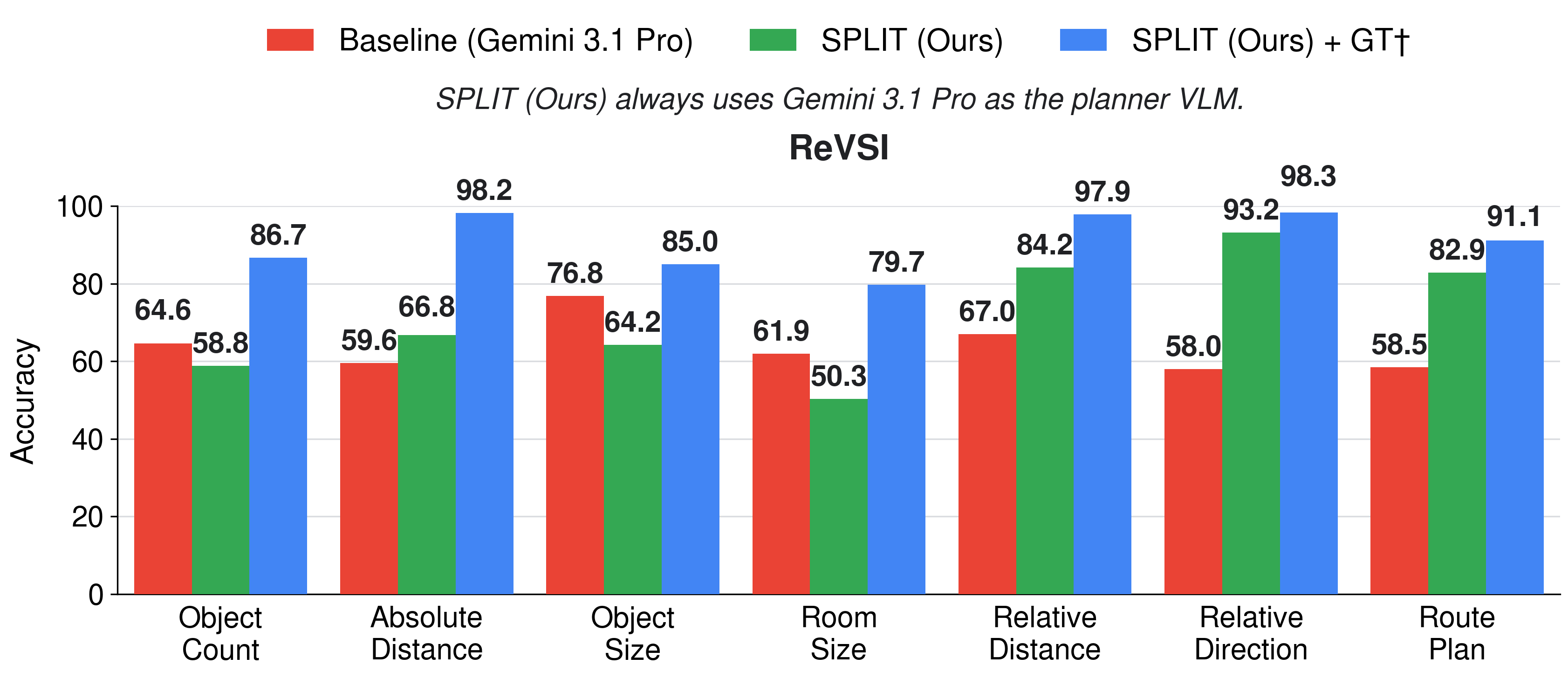
SPLIT (Ours) + GTTF3291.086.798.285.079.797.998.391.1

Bold and underlining mark the best and second-best full-benchmark scores. † Ground-truth diagnostic; the analysis subset is described in the paper, and counting is an oracle ceiling.

Ground Truth Closes the Gap in Every Category
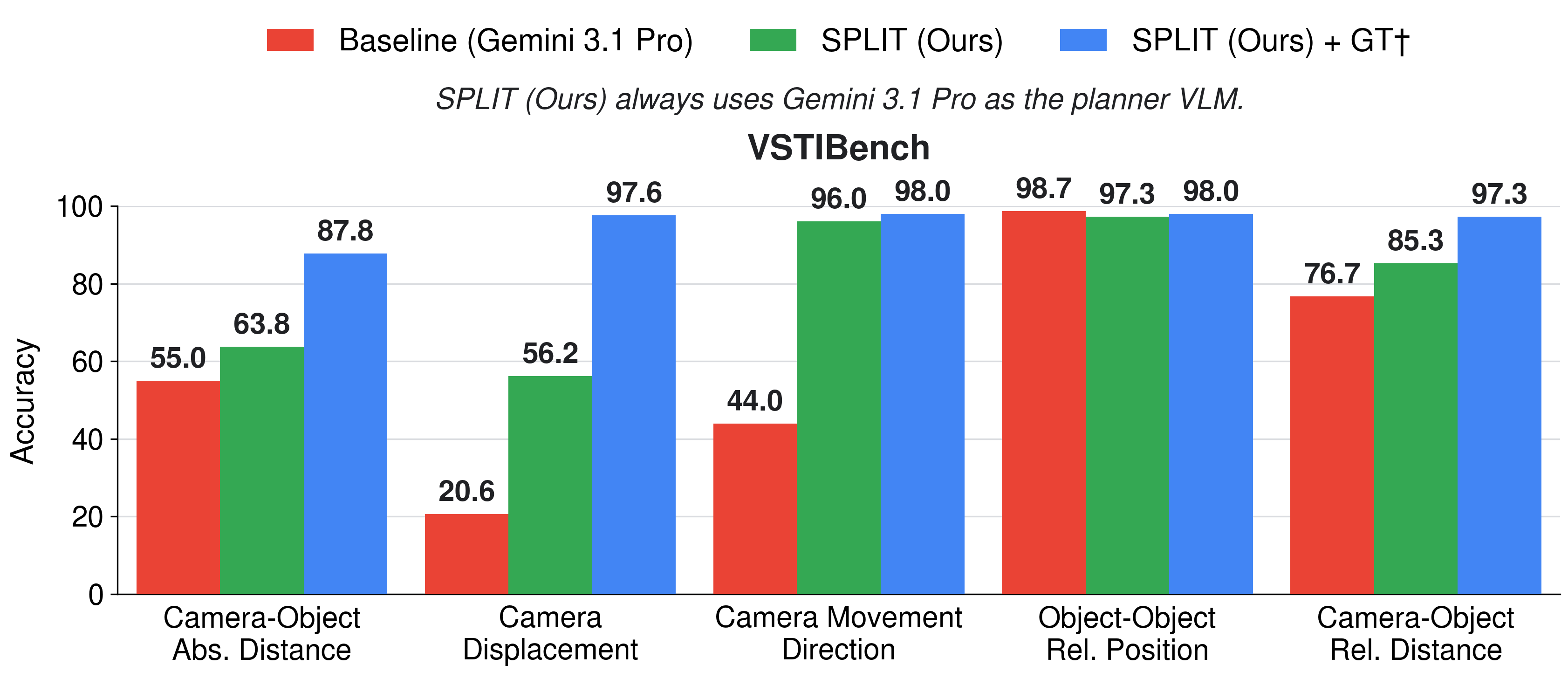
Per-category VSTIBench scores for the baseline VLM, SPLIT, and SPLIT with ground-truth measurements. Per-category VSIBench scores for the baseline VLM, SPLIT, and SPLIT with ground-truth measurements. Per-category ReVSI scores for the baseline VLM, SPLIT, and SPLIT with ground-truth measurements.

† SPLIT (Ours) + GT is measured on each benchmark's analysis subset; counting is an oracle ceiling on VSIBench and ReVSI. On VSIBench, appearance order uses a 50-question answerable cohort. On ReVSI, the baseline and SPLIT bars are full-benchmark scores and the ground-truth bars use the 981-question subset that excludes 18 route questions without complete annotations.

Conclusion

With ground-truth measurements in place of the tools’ estimates, SPLIT rises from 78.3 to 95.7 on VSTIBench: perception, not reasoning, is the bottleneck.

SPLIT improves VSIBench, VSTIBench, and ReVSI by 6.5, 20.6, and 7.7 points over the same planner VLM without tools.

BibTeX

@misc{yeung2026split,
  title  = {Perception, Not Reasoning, Limits Video Spatial Understanding},
  author = {Yeung, Jacob and Goyal, Mohit and Dubost, Florian and Vondran Jr., Gary L.
            and Tombari, Federico and Ramanan, Deva and Tarr, Michael J.},
  year   = {2026}
}